
Power Direct
Drivers can identify intermodal freight, share load details, upload delivery papers and proof of delivery, and track payments all in one spot through Power Direct.
5,000+ downloads on Android, with a combined 580+ ratings across both platforms averaging 4.5–4.7 stars.

Project Overview
IMC Companies, a 40-year leader in U.S. marine drayage, manages a fleet of 2,200+ drivers nationwide. Power Direct translates this operational scale into a streamlined digital experience, enabling drivers to find intermodal freight, share load information, upload proof of delivery, submit documentation, and track payments — all in one platform. By consolidating complex logistics workflows into a user-friendly interface, the app improves efficiency, reduces errors, and enhances visibility for both drivers and clients.
Problem
Drivers faced a fragmented and costly workflow across multiple apps, increasing cognitive load and operational errors. IMC needed a unified platform that:
-
Reduced task friction for drivers
-
Consolidated essential operations in one place
-
Maintained real-time visibility for dispatchers and administrators
-
Delivered cost savings and operational efficiency
Role
Lead UX/Product Designer
Duration
September 2022 -
Feb 2023
Platforms
iOS and Android
Tools
Figma
Miro
Teams
Jira
Process Overview
click to enlarge

Users and Insights
Drivers
Needed quick access to freight, proof of delivery uploads, documentation, and payment tracking.

Dispatchers
Required real-time visibility into fleet availability, load assignments, and issue resolution.

Admins / Operations
Needed reporting and oversight for operational efficiency.

Design Approach
Research Driven
qualitative interviews conducted with drivers, dispatchers, and operations stakeholders to understand pain points
Research insights directly informed a simplified navigation model, prioritized high-frequency driver tasks, and scoped features around real-time operational needs rather than tool parity with legacy systems.
Iterative design
2-week sprint cycles completed, enabling rapid iteration without delaying development timelines
Iterative testing validated streamlined driver workflows and reduced friction across core dispatch tasks prior to development.
Cross-functional collaboration
documented flows and specs delivered , translating complex operational needs into build-ready design.
Improved delivery efficiency and ensured design intent did not create roadblocks for app deadlines.
Solution Highlights
Enabling drivers to:
View and accept assigned intermodal loads
Access complete load details, terminal information, and required documentation
Update load status and share delivery progress in real time
Upload proof of delivery and supporting documents directly from the field
Designed around real-world driver behavior, minimizing missed steps and reducing errors across dispatch, delivery, and damages
Supporting multiple user roles (drivers, dispatchers, operations) and enabling consistent patterns across current and future features.
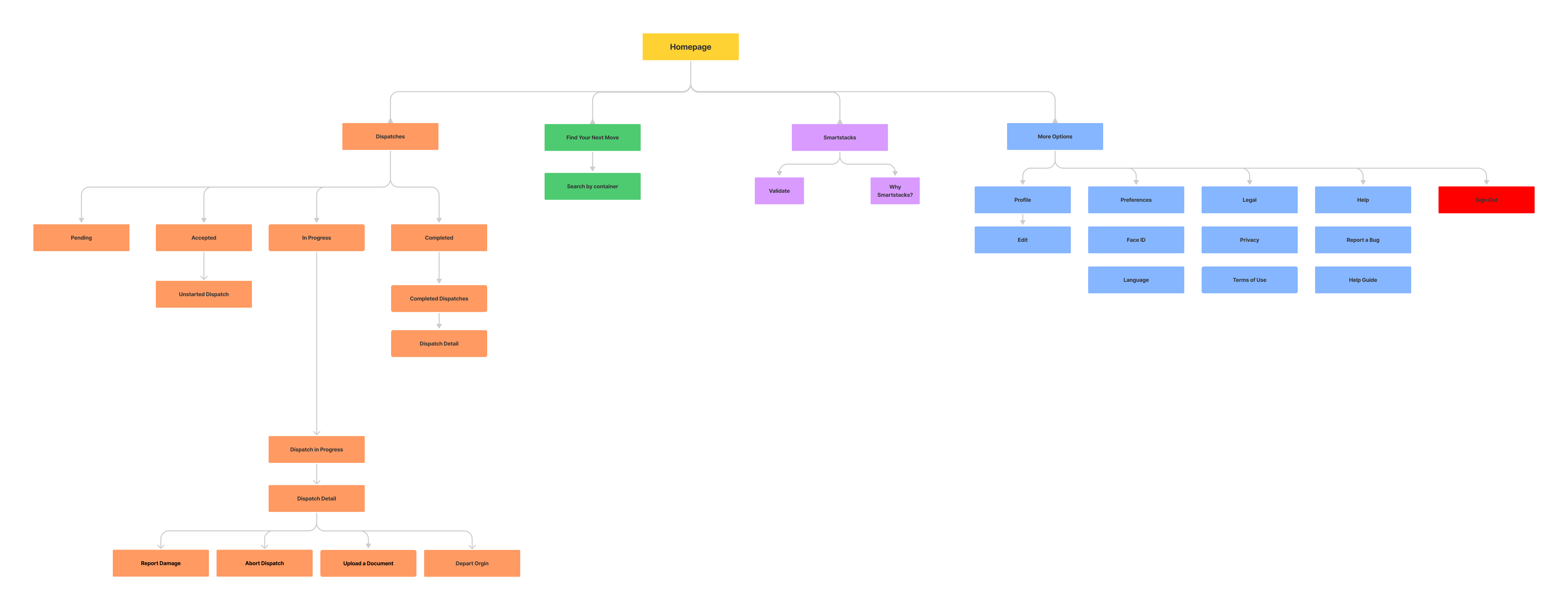
Information Architecture
click to enlarge
Key Designs
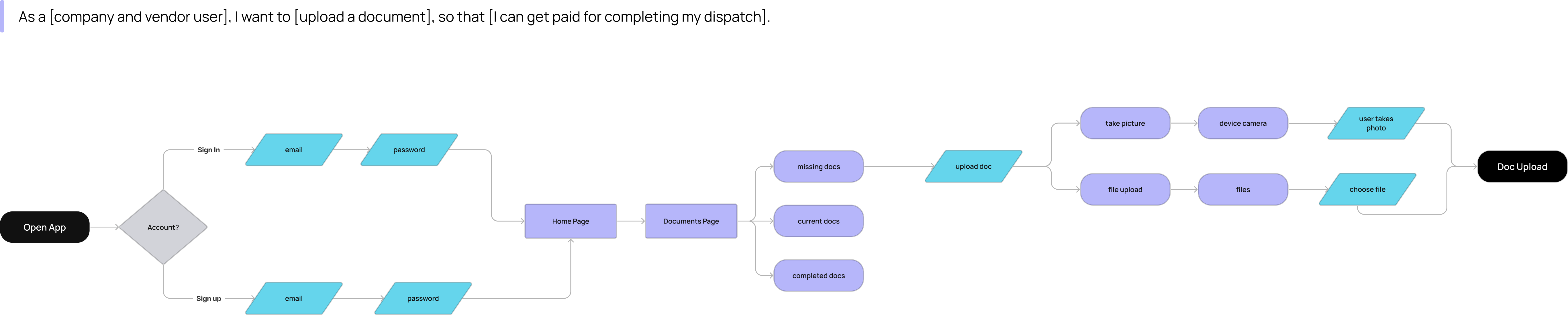
Document Upload
As a driver, I need to submit missing or rejected delivery documents directly through Power Direct so documentation issues can be resolved quickly without follow-up or manual intervention.
Outcome: Moves were invoiced faster when drivers were made aware of missing documents and provided an easier path to provide correct documentation.
Evidence: Insights from 10 qualitative interviews with field and internal users, combined with iterative refinement across 12 sprint cycles, highlighted the need for a dedicated Missing and Rejected Documents section. Designs that did not clearly surface missing or rejected documents created delays in the approval process.
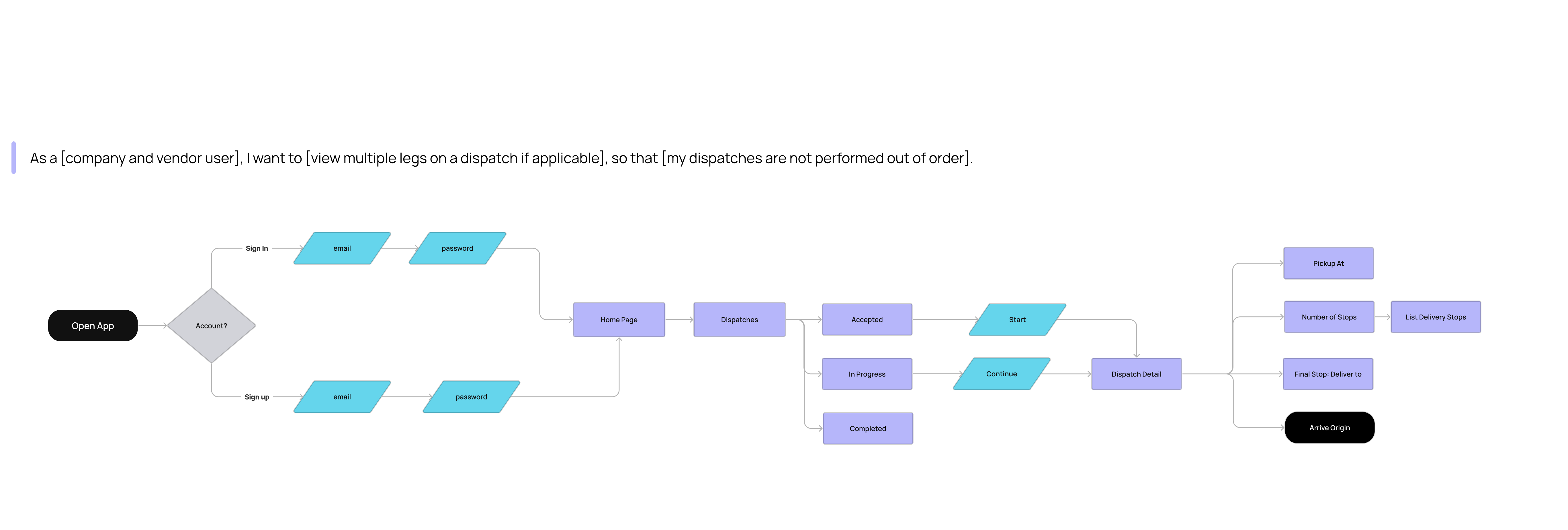
Dispatch Details
As a dispatcher, I need visibility into multi-leg dispatches within Power Direct so I can manage complex routes and assignments without relying on third-party tools.
Outcome: Enabling multi-leg dispatch in Power Direct streamlined the transition from third-party apps, as users can consolidated information from multiple stops and fulfilled all necessary dispatches.
Evidence: Research and analysis of prior third-party tools revealed that when dispatch legs were not grouped within a single assignment, redundant entries appeared in dispatch lists and certain legs were often sequenced incorrectly. This lead to operational delays and manual intervention.
Damage Form
As a driver, I need a clear way to report container damage at the time of pickup or delivery so responsibility is accurately documented and operational issues can be addressed promptly.
Outome: Repairs were expedited and reduced wait time when drivers reported lost or damaged chassis.
Evidence: Research from 12 user interviews and historical damage reports revealed that chassis damage and missing parts are common exceptions in the dispatch workflow. Without a structured reporting process, these incidents risked misattributed liability and increased operational overhead.
Reflection
Power Direct reinforced the importance of understanding multiple user types and their interdependent workflows. By focusing on the end-to-end experience, I was able to lead a platform redesign that balanced operational complexity and user needs, providing a blueprint for future large-scale design.